Your Email Agency's Numbers Might Be Lying to You — Here's How to Know for Sure
"Email drove 35% of revenue" sounds great on a report. But attribution is a hall of mirrors. Here's how to tell if your email program is actually growing your business — or just taking credit for it.
"Email drove 35% of revenue last month."
That line shows up in nearly every agency report. It sounds impressive. It makes everyone feel good about the retainer. And in a lot of cases, it's technically accurate, but deeply misleading.
Most ecom brands don't actually know if their email marketing agency is doing a good job. Not because the data isn't there, but because the data they're being shown is designed to look good, not to tell the truth.
The attribution problem no one talks about
Here's what's often happening behind the scenes when email "drives" a sale.
A subscriber opens an email. Maybe they glance at it, maybe they don't even register the content. They leave. Later that day or that week, they come back through a Facebook ad, or they type the URL directly into their browser. They buy. Email gets the credit.
This isn't fraud. It's just how most attribution models work. Last-touch or even multi-touch windows are generous with email because email touches almost everyone on your list at some point. So the numbers inflate naturally, and nobody questions it because the report looks great.
The result is that email can appear to be doing far more heavy lifting than it actually is. And when your agency's value proposition is tied to that number, there's very little incentive to correct the narrative.
How to actually evaluate your email program
If attribution percentages aren't reliable on their own, what should you be looking at instead? Here's the framework I use.
Total store revenue, before and after. This is the most honest metric. Forget what's "attributed" to email for a moment. Did the overall business grow after your email program improved? If total revenue went up meaningfully and nothing else changed dramatically - ad spend stayed flat, traffic sources remained consistent, email is likely a real contributor. If total revenue stayed the same but email attribution went up, that's just a reallocation of credit, not actual growth.
Repeat purchase rate. Email's primary job in ecommerce is retention. If your email program is working, more customers should be coming back for a second, third, and fourth purchase. Track this over time. If repeat purchase rate isn't climbing, your flows and campaigns aren't doing what they should be doing, regardless of what the attribution dashboard says.
Conversion rate over time. Is your overall site conversion rate trending upward? A strong email program warms up your audience before they even hit the site. Subscribers who receive consistent, valuable emails convert at higher rates when they do land on a product page. If conversion rate is flat or declining while email attribution is climbing, something doesn't add up.
The kill switch question. This is the most important one, and it's the question most agencies hope you never ask: "If we turned email off tomorrow, what would actually happen?" If the honest answer is "not much," then the program isn't driving real value. If the answer is "we'd lose a significant chunk of repeat revenue and customer lifetime value would drop," then you've got something real.
What real impact looks like
Here's an example from one of our accounts.
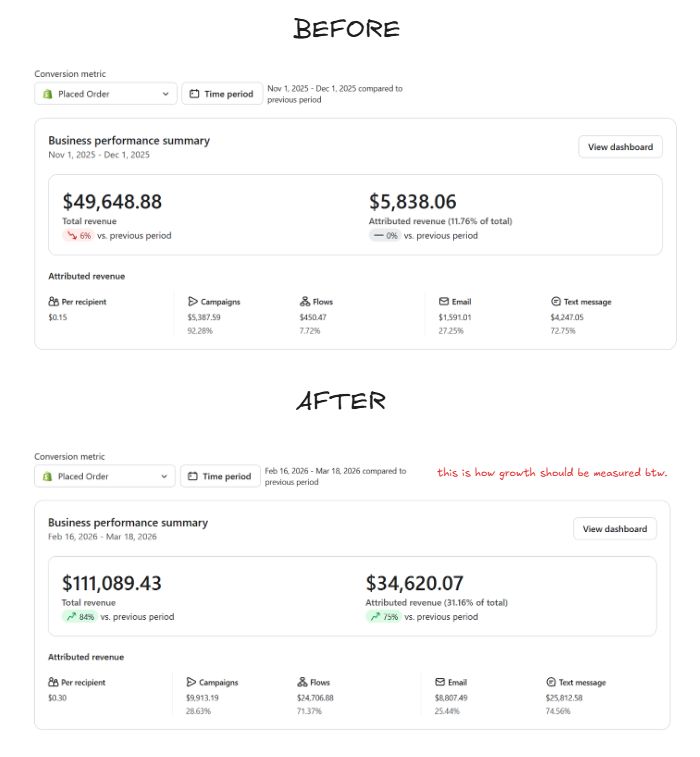
Before we took over, the brand was doing roughly $49K in total monthly revenue, with about $5.8K attributed to email. After rebuilding their email program - new flows, better segmentation, stronger campaign strategy. Total revenue climbed to approximately $111K per month, with around $34.6K attributed to email.
The important part isn't that email attribution jumped from $5.8K to $34.6K. The important part is that the entire business more than doubled. Email and SMS didn't just "look better" on a report. The store actually grew. That's the difference between attribution and impact.
Why even modest lifts matter more than you think
Here's where most people get the math wrong. Even if email only lifts your total revenue by 5–10%, that's a massive win. Here's why.
Email is owned revenue. There are no platform fees eating into your margins. There's no rising cost-per-click making each acquisition more expensive quarter over quarter. There's no algorithm change that can wipe out your reach overnight. Every dollar email generates is a dollar you're not dependent on Meta or Google to deliver.
So yes, email might report 30–40% of total revenue in your dashboard. The real number is probably lower. But the actual value of email isn't the attribution percentage — it's that it makes your entire business more resilient. Ads bring customers in. Email keeps them. Those are two fundamentally different jobs, and the second one compounds over time in a way that paid acquisition never will.
The real test of a good agency
A good email agency won't just show you attribution reports and call it a day. They'll show you impact. They'll walk you through how total revenue changed, how retention metrics moved, how customer lifetime value trended after their work began.
They'll be honest about what email can and can't take credit for. They'll explain the difference between correlation and causation in your data. And they'll be comfortable with the kill switch question because they know the answer works in their favor.
If your agency can't explain any of that clearly — if every conversation starts and ends with "email drove X% of revenue" — you're probably being sold numbers, not growth. And in ecommerce, there's a very expensive difference between the two.