Stop Sending Emails to Everyone — How Smarter Segmentation Fixes Declining Performance
Brands with 100K+ lists are getting 7-10% open rates. Not because their emails are bad, but because they're sending to everyone. Here's how to fix it by sending to fewer people, not more.
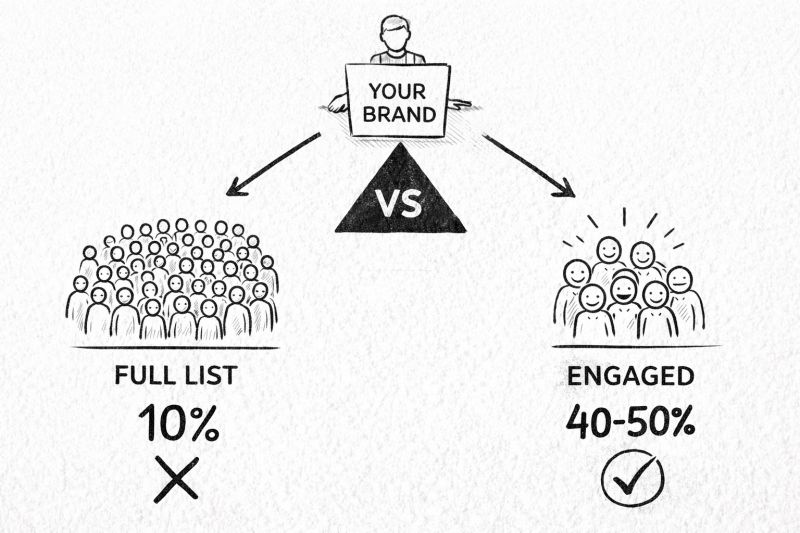
There's a counterintuitive truth in email marketing that most brands learn the hard way: sending to more people usually makes your results worse, not better.
I see it constantly. A brand has a list of 100K+ subscribers. Their open rates are sitting at 7–10%. They assume the problem is the content: the subject lines aren't good enough, the design needs work, the offers aren't compelling. So they invest in better creative, keep sending to the full list, and watch the numbers stay flat or keep declining.
The content was never the problem. The audience was.
Why sending to everyone hurts you
Email isn't like social media where more impressions are generally better. Every email you send is being evaluated - not just by the person receiving it, but by the inbox provider delivering it.
Gmail, Yahoo, Outlook - they're all watching how your subscribers interact with your emails. When a large chunk of your list ignores you consistently, those providers notice. And their conclusion is simple: if most of the people you're emailing don't want to hear from you, why should we put your emails in anyone's inbox?
That's how deliverability spirals start. You send to everyone. Most people don't engage. Inbox providers throttle you. Now even the people who do want your emails stop seeing them. Open rates drop further. You send more to compensate. The spiral accelerates.
The fix isn't sending more. It's sending to fewer people. The right people.
Email is earned, not guaranteed
The simplest way to think about this: email attention is earned. A subscriber opted in at some point, but that doesn't mean they're interested right now. People's lives change, their needs shift, their inboxes get crowded. If someone hasn't opened or clicked one of your emails in months, they're telling you something through their silence.
That doesn't mean they're gone forever. But it does mean you should stop treating them the same as someone who clicked yesterday. Continuing to send to disengaged subscribers doesn't just waste sends - it actively damages your ability to reach the people who do care.
How to build a clean sending list
The process is straightforward. Start tight, then expand carefully.
Start with your engaged core. Your initial sending audience should be subscribers who have opened or clicked within the last 30 days. These are the people who are actively paying attention. They're your highest-probability audience for opens, clicks, and conversions and sending to them signals to inbox providers that your emails are wanted.
Remove the obvious exclusions. Take out anyone who just purchased and is already in a post-purchase flow. Remove hard bounces, those addresses are dead and every send to them hurts your sender reputation. And suppress the subscribers who haven't opened a single email in a very long time. They're not helping your metrics and they're actively hurting your deliverability.
Now you have a clean list. It's going to be smaller than what you're used to sending to. That's the point. This is your foundation - the audience that actually wants to hear from you.
Expand gradually, watch the data
Once you've established a baseline with your engaged segment, you grow the audience slowly. Move from 30-day engaged to 60-day engaged. Watch what happens to your open rate. If it holds steady or dips only slightly, you're fine, keep going. Expand to 90 days. Monitor again.
At some point, you'll see a meaningful drop in open rate. That's your boundary. That's the point where you're including too many disengaged subscribers and starting to dilute your performance. Pull back to where the metrics were healthy, and that becomes your standard sending segment.
This isn't a one-time exercise. It's an ongoing discipline. Your engaged window will shift over time as your list grows, as seasons change, and as your content strategy evolves. The brands that maintain strong email performance are the ones that revisit their segmentation regularly and resist the temptation to blast the full list just because it's there.
Sending smarter, not harder
Most brands try to grow email revenue by sending more — more campaigns, more frequency, more subscribers on every send. The best brands grow by sending smarter. They'd rather send one email to 30K engaged subscribers and get a 35% open rate than blast 100K people and get 8%.
The math actually works out in their favor. A 35% open rate on 30K subscribers means 10,500 people saw your email. An 8% open rate on 100K means 8,000. Fewer sends, more eyeballs, better deliverability, and a healthier sender reputation that compounds over time.
If your email performance has been declining, it's probably not random. It's probably not your subject lines or your design or your offer. You're likely talking to people who stopped listening a long time ago, and inbox providers are penalizing you for it.
Segmentation isn't an advanced tactic. It's common sense applied to a channel that rewards relevance and punishes noise. Start with the people who actually engage, build from there, and let the data tell you when to stop.
Your list size is a vanity metric. Your engaged list size is the one that drives revenue.